HAM RADIO FOR CRUISING YACHTS
Ham radio is the realm of a world-wide group of radio enthusiasts. Operators have been involved in many life saving efforts with sailors, but regrettably radio operators and the system have been badly abused by some yachtsmen. The Ham Radio is a major communication source in the cruising world.
In the US, about 70% of cruisers sail with ham, while UK and Australia it is probably around 10%. There are a number of important factors to consider with respect to ham radio operation.
HAM RADIO OPERATOR LICENSING
It is the operator not the station that is licensed. There are a number of levels that give either partial or full access to frequencies.
Levels require examination in Morse, radio theory, rules and regulations with respect to operations. It is this fear of technical matters and theory as well as the Morse that frightens many would be amateurs.
A ham radio general class license will be required for access to Maritime Mobile Nets in the 15, 20 and 40 metre bands.
HAM RADIO PENALTIES
You must be licensed for the country of operation, and beware in some third world countries were communications are controlled, jail and vessel loss can occur if it is used in port and without authorisation. In many cases you will not be acknowledged on ham radio bands unless you are licensed and have a call sign.
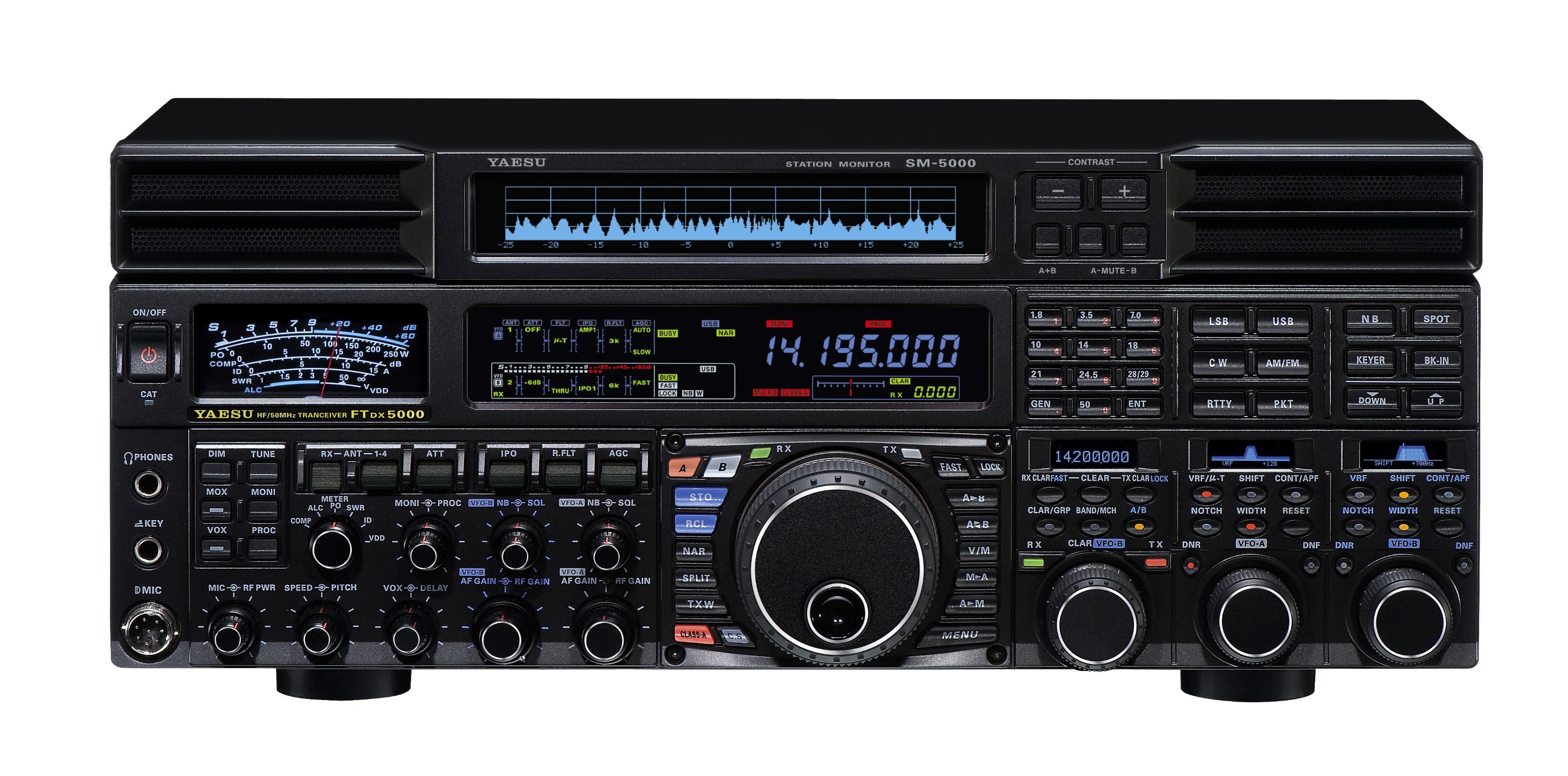 Top of the line Yaesu FT DX5000MP, image courtesy of Yaesu. Stay in touch out there.
SSB VS HAM-RADIO
This argument is never ending. Both systems have a place, well actually SSB is virtually gone so argument is essentially over. In an ideal world carry both systems. SSB Radio sets are generally easier to operate for non technical people, and with automatic tuning it is simple to punch in a channel number and talk. Additionally radios have automatic emergency channel selection.
Radios are also type approved for marine communications. Only a Restricted Radio Telephone Operators Permit is required. It is allowable to operate a SSB radio on amateur frequencies if you have a ham radio licence. One of the disadvantages of SSB on ham radio frequencies is that synthesizers are programmed in 0.10kHz steps. As is often the case, ham communications may be at frequencies outside of that so that SSB sets can be marginally off frequency.
Most SSB sets operate on Upper Side band (USB) while most ham frequencies below 40 metres are Lower Side Band (LSB). The ham operator must have a license appropriate to the frequency band being worked. Access to GMDSS emergency frequencies is illegal except in emergencies. It is illegal to operate non type approved radios such as ham radios on marine frequencies. Ham allows the use of casual conversation and chit-chat which marine SSB does not. Ham allows full access to information packed nets, and a worldwide communications network. Ham radio does not readily allow access to telephone networks, although some stations offer phone patches.
These days with the near absence of SSB shore stations ham is the only way to go when cruising. Most popular Ham radio sets appear to be Kenwood and Yaesu.
MARITIME NETS 0000 - 0900 hours
This is a very good and useful selection of Ham Radio Nets extracted from the listings in the Marine Electrical & Electronics Bible. If you are not a licensed operator, invest in a receiver only and listen in to the nets, the information can be invaluable. I cannot vouch for the accuracy of these nets and trying to research and update them as regularly as possible.
Times in UTC followed by frequency in MHz and Net Name
0025 - 14.232 - Mobile Maritime Net
0100 - 21.407 - Pacific Indian Ocean Net
0200 - 14.313 - Pacific Seafarers Net
0400 - 14.340 - MARITIME EMERGENCY NET
0500 - 14.303 - Tony's Net (Red Sea & Indian Ocean)
0500 - 8.297 - Peri-Peri Radio East Africa
0530 - 14.316 - Peri-Peri Radio East Africa (after wx)
0630 - 14.316 - South African Maritime Mobile Net
0700 - 14.118 - Le Reseau Du Capitaine Net
0700 - 14.303 - International Net
0700 - 7.085 - Mediterranean Maritime Mobile Net
0800 - 7.238 - PST Baja California Maritime Mobile Net
0800 - 14.303 - UK Maritime Mobile Net
0800 - 14.315 - Pacific Inter-island Net
0830 - 12.359 - Russell Radio (Pacific/NZ)
0830 - 8.152 - Cruiseheimers Net
0900 - 14.313 - Mediterranean M/M Net
MARITIME NETS 0900 - 1600 hours
1000 - 14.315 - Robby’s Net
1030 - 7.080 - Caribbean Weather Net
1030 - 14.265 - Caribbean Weather Net
1100 - 7.230-7.240 - Caribbean Maritime Mobile Net
1115 - 14.320 - Roy’s Net
1130 - 14.320 - South African Maritime Mobile Net
1200 - 14.340 - Manana M/M Net (Hawaii, West Coast US)
1230 - 7.237 - Caribbean Net
1245 - 14.121 - Mississauga Net (Atlantic, Med, Caribbean)
1300 - 21.400 - Transatlantic Net
1330 - 8.107 - Panama Canal Connection Net
1400 - 8.188 - NW Caribbean Cruisers Net
1400 - 7.292 - Florida Coast Net
1400 - 8.188 - Northwest Caribbean Cruisers Net
1530 - 7.294 - Chubasco Net
1545 - 14.340 - Marquesas Net
1600 - 14.331 - US Coast Guard Net
MARITIME NETS 1600 - 2400 hours
1630 - 14.313 - German Maritime Mobile Net
1630 - 12.359 - Russell radio (Pacific/NZ)
1700 - 14.300 - Maritime Mobile Service net
1700 - 14.329 - Skippers Net
1700 - 14.340 - California Hawaii Net
1800 - 14.340 - MARITIME EMERGENCY NET
1800 - 14.303 - UK Maritime Mobile Net
1800 - 14.282 - South Pacific Net
1800 - 7.076 - South Pacific Cruising Net
1900 - 14.305 - Confusion Net (Pacific)
2000 - 12.359 - Herb Hilgenbergs Southbound Net (SSB)
2000 - 14.297 - Italian Maritime Mobile Net
2030 - 14.303 - Swedish Maritime Net
2040 - 7.087 - Comedy Net (Pacific/Australia)
2100 - 14.316 - Tony’s Net (South Pacific, Aust & NZ)
2130 - 14.290 - East Coast Waterways Net
2200 - 21.412 - Pacific Maritime Mobile Net
2300 - 14.315 - Robby’s Net
2400 - 14.320 - SE Asia M/M Net
All about boat radios at fishing and boats.